 Tromsø Northern Lights Trips
How to Read the Tromsø Northern Lights Forecast

A Tromsø northern lights forecast is really three separate forecasts stapled together, and most visitors read only the one that matters least. Kp gets all the attention because it is a single number on a scale of 0 to 9, easy to screenshot and easy to misread. At 69.6°N, under the auroral oval itself, a Kp of 2 already puts a green arc on the northern horizon, so chasing a high Kp number is often chasing the wrong thing. What actually decides your night is cloud cover, and the guides who beat it, on 93% of tours, are reading a cloud map before they look at anything else. Below is the order we read a forecast, the tools worth your time, and what to do with what you find.
Quick answer
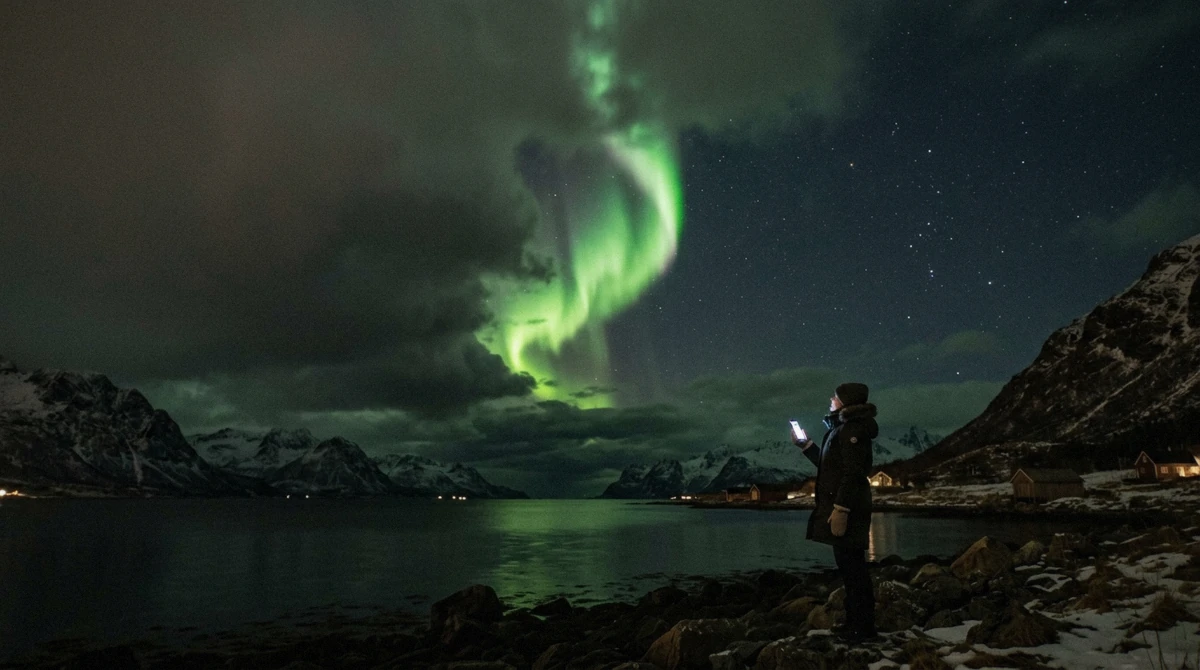
Read cloud cover first, Kp second, solar wind third. A clear sky with a modest Kp beats a cloudy sky with a high one every time, which is exactly why the northern lights chases that drive to find clear sky outperform anyone staring at a phone from a hotel window.
Key takeaways
- Cloud cover decides more nights than the Kp number does, guides found clear sky on 93% of tours by driving to it
- Kp 2 already means a green arc at this latitude, Kp 5 means colour overhead to the naked eye
- Solar wind satellites give 30 to 60 minutes of real warning, useful once you are already outside
- October is the strongest measured month at 94.2%, well ahead of September's 84%
- The 27-day outlook is a solar-rotation forecast, not a weather forecast, do not plan a specific evening around it
- A storm alert mid-tour is a reason to check tonight's availability, not a reason to panic
What the Kp Number Does and Does Not Tell You
Kp is a 3-hour global average on a 0 to 9 scale, built for geophysicists tracking planet-wide magnetic disturbance, not for one traveller standing in one town. It was never designed to answer "will I see anything from Tromsø tonight," and treating it that way is the single most common mistake we see in visitors' forecast screenshots.
Tromsø sits at 69.6°N, directly under the auroral oval, so the threshold for a visible display here is much lower than it is for a place at 55°N chasing a rare southward dip. Kp 2 at this latitude already puts a faint green arc low on the northern horizon. Kp 3 to 4 brings curtains with visible rays, moving and folding rather than sitting still. Kp 5 or higher tends to bring colour overhead, the kind of display that needs no explanation once you are standing under it.
Here is what each band actually looks like from town or from a chase point outside it, in table form so you can check it against tonight's number without re-reading the paragraph above.
| Kp value | What you actually see at 69.6°N |
|---|---|
| Kp 2 | A faint green arc low on the northern horizon, best from a dark spot away from streetlights |
| Kp 3 to 4 | Curtains with visible rays, movement and folding overhead or to the north |
| Kp 5+ | Colour visible to the naked eye, often directly overhead, the display most photos show |
A Kp 2 night with clear sky at Telegrafbukta can beat a Kp 5 night buried under overcast fifty kilometres away. That is not a hedge, it is the entire logic behind why guides drive rather than wait.
The Forecast a Guide Actually Reads
We read three layers, in this order, every single evening before deciding where the vehicle goes. Cloud first, because a perfect Kp under an overcast sky shows you nothing. Kp second, because it sets rough expectations for how strong a display might be if the sky cooperates.
Solar wind data third, because it is the closest thing to a live, short-notice signal once you are already out and watching.
| Tool | What it tells you | How far ahead | Worth checking when |
|---|---|---|---|
| yr.no cloud map | Where the sky will be clear tonight, hour by hour | Up to 9 days, most reliable inside 48 hours | Every afternoon before you decide where to go |
| NOAA OVATION 30-minute forecast | Where the auroral oval sits right now and over the next half hour | 30 minutes | Once you are outside and deciding which direction to face |
| NOAA 3-day geomagnetic forecast | Expected Kp range for the next three nights | 3 days | Planning which of your nights in town to book a chase |
| Tromsø Geophysical Observatory magnetometer | Live local magnetic disturbance, a real-time read on activity overhead | Live, no lead time | While you are already watching, to see if activity is building |
| Norway Lights | A traveller-friendly combined view of Kp and cloud for Norway | Same night to a few days | A quick single check before heading out |
| 27-day solar-rotation outlook | Which weeks might repeat a coronal-hole stream from a month earlier | 27 days, recurrence-based | Roughly planning which week of a trip to book, not which night |
Cross-check yr.no against NOAA's 30-minute OVATION forecast and you have the two numbers that matter for tonight. The 3-day forecast is for picking which of your evenings in town to commit to a chase, not for judging the next six hours.
Solar wind is the layer most visitors never learn to read, and it is the closest thing to a live warning system available to a traveller standing outside. Satellites stationed well ahead of Earth measure the speed of the solar wind and the direction of its embedded magnetic field, and that data gives 30 to 60 minutes of real warning before a change reaches the atmosphere over Tromsø. A southward turn in that magnetic field is the signal guides watch for once everyone is already parked and waiting, since it often precedes a burst of activity by roughly that same half hour to hour.
It will not tell you anything useful from a hotel room in the afternoon, but once you are outside with a clear sky overhead, it is worth a glance on a phone between shots.
Reading Tonight: A 20-Minute Routine
This is the exact sequence we run through most afternoons before a chase, start to finish in about 20 minutes.
- Open yr.no and check the cloud map for Tromsø and the routes west and south, note which direction looks clearest
- Check the NOAA 3-day forecast for the expected Kp range tonight
- Open NOAA's OVATION 30-minute forecast to see where the oval currently sits
- Check the Tromsø Geophysical Observatory magnetometer for any live spike in activity
- Glance at Norway Lights for a second opinion on the same two numbers
- Decide your direction based on cloud, not Kp, and commit before dark
Twenty minutes sounds like a lot for what amounts to checking a handful of tabs, but the value is in the order, not the speed. Checking Kp before cloud, which is what most first-time visitors do, leads to the wrong decision more often than not, since a high Kp number under a solid overcast still shows nothing. Run the sequence in this order every afternoon of your trip and the routine takes closer to ten minutes once you know where to look.
3-Day, 7-Day and 27-Day Forecasts, and What Each Is Worth
The 3-day geomagnetic forecast from NOAA is the most useful long-range tool a traveller has, giving an expected Kp range for each of the next three nights with reasonable confidence. A 7-day outlook exists on some sites but confidence drops fast past day three, treat it as a rough mood rather than a plan.
The 27-day outlook is different in kind, not just in length. It is a solar rotation recurrence forecast: the sun rotates roughly every 27 days, so a coronal-hole stream that disturbed the geomagnetic field a month ago can swing back around and do it again. It is genuinely useful for spotting which week of a longer trip might run hotter than another, and useless for judging Tuesday specifically. Solar Cycle 25 peaked in October 2024, and its declining phase keeps activity above the long-term average into 2027, with these coronal-hole streams recurring roughly every 27 days through that stretch.
What to Do With Tonight's Forecast
If yr.no shows thin, patchy cloud over town but clear skies twenty minutes out
trust the operators to drive, this is exactly the pattern that produces the 93% clear-sky rate
If yr.no shows total overcast in every direction within reach
expect a quieter night for photography, some tours still run since the sky can open in pockets, but temper expectations
If the sky is clear but NOAA shows a low Kp
still go outside, Kp 2 to 3 at this latitude is a real, visible arc, not nothing
If a storm alert lands while you are already on a tour
stay outside and watch, the guide will already be repositioning toward the clearest patch of sky
Chances by Month, With the Measured Numbers
The most useful data we have is not a forecast at all, it is a season's worth of actual results: 1,346 chase tours tracked across 81 observing nights between 1 September and 20 November 2025, with 89.4% of them seeing the aurora, naked eye or camera. October led the season at 94.2% across 612 tours, followed by November at 87% across 456 tours in the first three weeks alone, with September at 84% across 278 tours. Nights with Kp 3 or higher made up 61% of the tracked period, which tells you most nights do not need a strong storm to succeed, they need clear sky and a guide willing to drive for it.
Aurora season overall runs late September to early April, with peak months from November to February. Activity is strongest roughly 6 p.m. to 2 a.m., with the best odds concentrated between 9 p.m. and midnight. Around the equinoxes, late September and late March, geomagnetic activity tends to tilt higher for reasons tied to the angle between Earth's magnetic field and the solar wind, a real seasonal bump worth knowing if your dates are flexible.
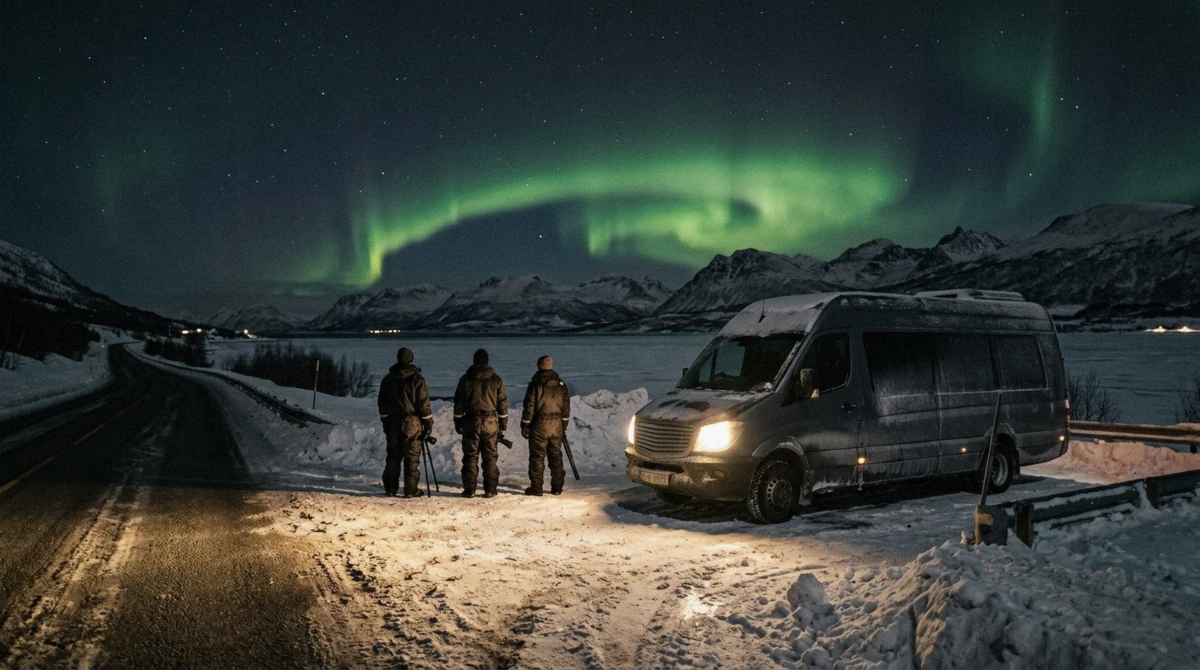
None of this replaces judgement built from doing it night after night, but reading the forecast in the right order gets you most of the way there on your own. If you would rather someone else carry that judgement for you, that is exactly what tour-6 is built around: a guide whose whole job that evening is deciding where the sky is clearest and driving until they find it.
If you are still choosing dates rather than reading tonight's numbers, the month-by-month picture sits in our guide to the best time to see the aurora here, and the question of how long to stay is answered in how many nights you actually need. If you would rather watch the sky on your own terms, we map the free spots in seeing the lights without a tour.
Frequently Asked Questions
How likely am I to see the northern lights in Tromsø?
Measured across 1,346 tracked chases in autumn 2025, 89.4% of tours saw the aurora, naked eye or camera. October ran highest at 94.2%, largely because guides found clear sky on 93% of tours by driving to it rather than waiting in one spot.
What is the best month to go to Tromsø for the northern lights?
October measured the strongest success rate in the tracked data, 94.2%, though the wider peak season runs November to February when nights are longest. November still measured 87% in the first three weeks alone.
Are the northern lights visible tonight in Norway?
Check yr.no for cloud cover first, then NOAA's 30-minute OVATION forecast for where the oval currently sits. A clear sky with a modest Kp beats a cloudy sky with a strong one, so cloud is the number to check first, not Kp.
What is the blue hour in Tromsø?
Blue hour here is not the usual dawn-and-dusk window, it is the long blue midday twilight that sits over the city during polar night, 27 November to 15 January, when the sun never rises but a soft blue light still fills the sky around midday.
What does the 27-day aurora forecast actually predict?
It is a solar-rotation recurrence forecast, not a weather forecast. The sun rotates roughly every 27 days, so a coronal-hole stream that stirred activity a month ago can swing back and do it again, useful for judging which week might run hotter, useless for judging a specific evening.
Which aurora forecast app should I use in Norway?
We check yr.no for cloud, NOAA's OVATION 30-minute forecast for real-time oval position, and the Tromsø Geophysical Observatory for a live magnetometer read. Norway Lights bundles a traveller-friendly version of the same two numbers if you want one app rather than three tabs.
Why does Kp matter less in Tromsø than other places?
Kp is a 3-hour global average built for geophysics, not for one town. Tromsø sits at 69.6°N under the auroral oval itself, so a Kp that would show nothing at 55°N already produces a visible arc here, at Kp 2.