 Tromsø Northern Lights Trips
Best Time to See the Northern Lights in Tromsø: Month by Month

The best time to see the northern lights in Tromsø is November through February, when the polar night stretches usable darkness past twenty hours a night and cold, stable air backs up the highest sighting rates we track. October is close behind on raw numbers: our operators logged a 94.2 percent sighting rate that month in 2025, ahead of both September and November. Anyone weighing the best time to see the northern lights in Tromsø for a single trip should aim for the run from mid-October to February, with October and early February the best combination of dark hours and manageable cold. September and March both catch a lift from the equinox, so neither shoulder month is a consolation prize. What follows is the month-by-month breakdown, including where the polar night's extra darkness does, and does not, actually help you.
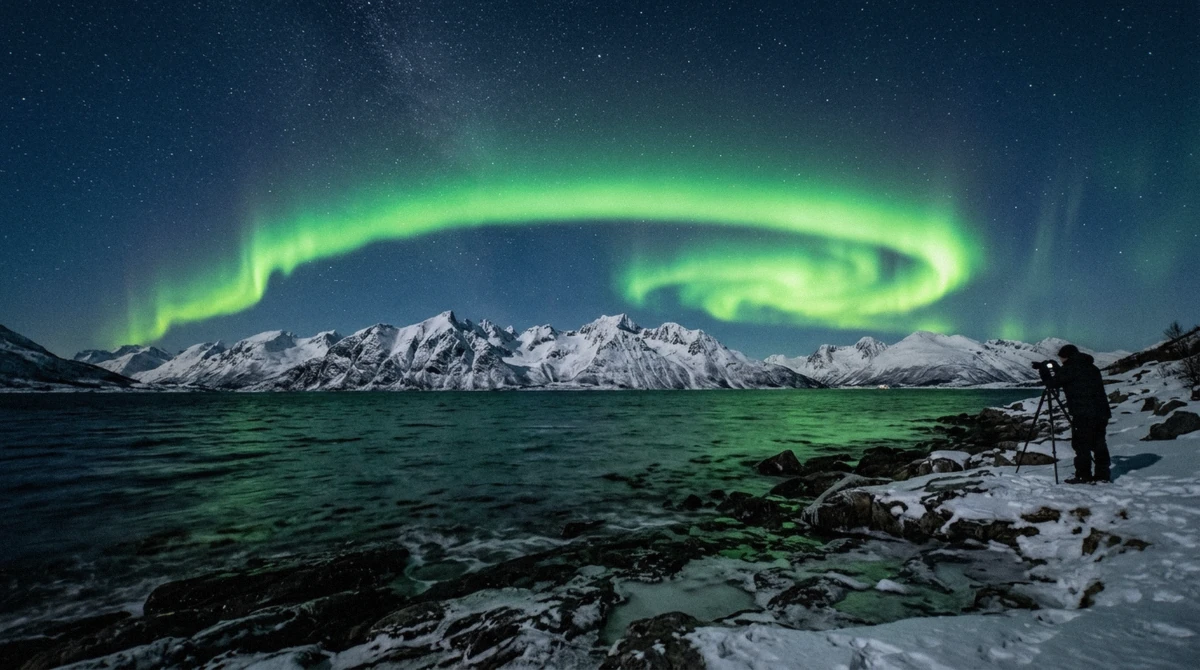
Quick answer
November through February is the best time to see the northern lights in Tromsø, when up to 21 hours of darkness a night meets the highest measured sighting rates we track. October comes close on raw numbers, and the shoulder months of September and March both catch a lift from the equinox rather than acting as fallback options.
Key takeaways
- November through February gives the darkest skies, up to 21 hours of usable darkness a night in December
- October logged the highest measured sighting rate in our tracked dataset, 94.2% of 612 tours
- September and March both get a boost from the equinox, when geomagnetic activity tends to run higher
- Guides found clear sky on 93% of tours across the season, so the calendar date matters less than who is driving that night
- Locked into fixed dates? Booking two separate nights, like the Northern Lights Safari and Snow Travels, beats one long booking regardless of month
- Planning your trip length too? See how many nights you actually need
Seasons at a Glance
Read the Verdict column first if you only have a minute: it's the short call for that month, everything else in the table is the reasoning behind it. Darkness figures are the approximate usable dark hours around the middle of each month; night lows are typical averages, not a forecast for any one night.
| Month | Darkness | Night low | Conditions | Verdict |
|---|---|---|---|---|
| January | ~19 hours | -6°C | Peak season, tail of polar night | Best overall pick |
| February | ~14 hours | -6°C | Peak season, clear cold spells common | Excellent, fewer holiday crowds |
| March | ~10 hours | -4°C | Equinox lifts geomagnetic activity | Strong, equinox boost |
| April | ~5 hours | -1°C | Season closing, dark window shrinking fast | Good, window closing |
| May | 0 hours | 3°C | Midnight sun approaching, no real dark | Skip, no darkness |
| June | 0 hours | 7°C | Full midnight sun | Skip, midnight sun |
| July | 0 hours | 10°C | Full midnight sun continues | Skip, still midnight sun |
| August | ~3 hours | 9°C | Aurora season not yet open | Too early, off season |
| September | ~9 hours | 5°C | Season opens late month, equinox lift | Season opens, good odds |
| October | ~13 hours | 1°C | Our best measured sighting rate | Best measured success rate |
| November | ~18 hours | -3°C | Polar night begins on the 27th | Peak season starts |
| December | ~21 hours | -5°C | Full polar night, tightest booking | Darkest, book weeks ahead |
The pattern is straightforward: darkness builds from September, peaks in December, and collapses fast after the equinox in March. Cold builds on a slower curve, bottoming out in January and February rather than December, which is one reason the deepest polar night isn't automatically the most comfortable pick.
The month-by-month table above covers conditions; this second table is measured, not estimated. Over 81 observing nights across eight Tromsø operators between 1 September and 20 November 2025, 1,346 tracked chases logged the following by month.
| Month | Tours tracked | Aurora sighted |
|---|---|---|
| September | 278 | 84% |
| October | 612 | 94.2% |
| November (1st to 20th) | 456 | 87% |
| Full dataset (81 nights) | 1,346 | 89.4% |
October's 94.2 percent stands out because it combines genuinely dark evenings with generally settled autumn weather, before the heavier winter fronts that can sit over Troms for days at a stretch move in. Guides also found clear sky on 93 percent of all tours in the dataset, which means the driving and rerouting they do matters as much as the month you land in.
Month by Month in Brief
January: the tail of polar night, -6°C, paired with February as the darkest, most reliable stretch of the year. February: the coldest average night at -6°C, but often the calmest, clearest air of the season. March: the equinox lift begins, milder at -4°C, with darkness already shrinking fast.
April: the last real dark window, -1°C, worth booking early in the month before it closes. May through July: essentially no usable darkness, genuinely not worth planning around. August: still pre-season even though nights are cool, the sky simply isn't dark enough yet.
September: the season opens, an equinox lift, and our tracked data shows 84 percent of tours saw the aurora. October: the best measured month in our dataset at 94.2 percent, with mild -1°C to 1°C nights. November: polar night begins on the 27th, and 87 percent of tours in the first three weeks saw the aurora.
December: the longest darkness of the year, and also the tightest month for booking a seat.
Best Month by Traveller Type
If a photographer chasing long exposures under a dark sky
aim for December or January, when up to 21 hours of darkness gives the widest shooting window each night.
If traveling with family and want milder cold
come in October or early November, when night lows sit around 1°C to -3°C rather than the -6°C of deep winter.
If a first-timer chasing the best possible odds
book October, our highest measured sighting rate at 94.2% across 612 tracked tours.
If traveling on a budget
avoid December and the New Year weeks, when availability is tightest and the smallest minibuses fill first; September and October see less demand.
If locked into fixed dates outside the peak months
don't worry about the calendar too much: guides found clear sky on 93% of all tours, so two chases on separate nights matter more than the month you're stuck with.
Polar Night, and Why December Is Not Automatically Best
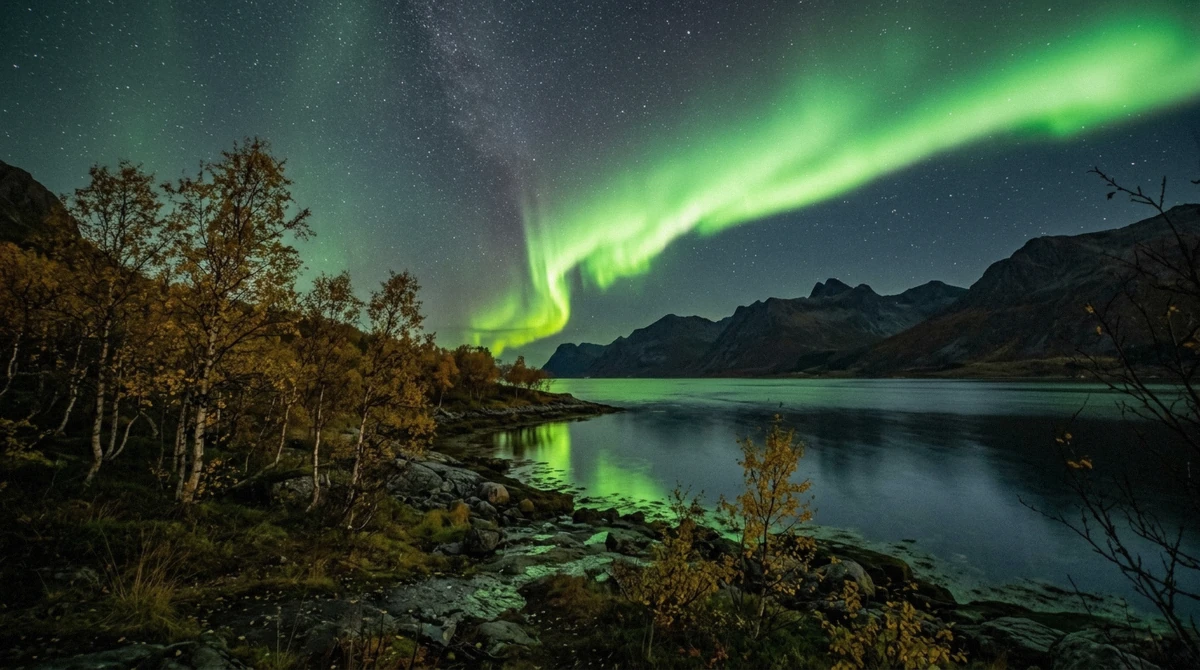
Polar night in Tromsø runs from 27 November to 15 January: the sun never rises, and mountains ringing the fjord widen the practical dark period by a few days at each end. Even at local noon, a blue half-light sits over the city rather than real daylight, a strange, quiet light that first-time visitors often mention as much as the aurora itself. That gives December the longest usable darkness of the year, close to 21 hours by the middle of the month, and it is easy to read that number as an automatic recommendation.
It isn't, quite. Night lows average around -6°C in the deepest part of winter, colder than the shoulder months, and December through the New Year weeks is also the tightest stretch for tour availability, since the small minibuses that tend to run the best-performing groups fill first. There's also a practical side to the extra darkness that's easy to miss: 21 hours of usable dark doesn't mean 21 hours of good viewing, since most chases still run within the same 6 p.m. to 2 a.m. window regardless of how early the sun set that afternoon. If your dates are flexible, the combination of cold and crowding in December is worth weighing seriously against the extra hour or two of darkness it buys you, especially since January carries almost the same darkness with a calmer booking calendar.
The Shoulder Months, September and March
September and March don't get the deep darkness of December, but both sit near the equinox, when geomagnetic activity tends to run higher than the seasonal average. We tracked 278 tours in September 2025 and 84 percent of them saw the aurora, a respectable number for a month when full night doesn't arrive until closer to nine in the evening and usable darkness runs to around nine hours by mid-month.
March runs the same equinox effect as the season closes, with milder night lows, around -4°C, and about ten hours of usable darkness by mid-month, more than September gets even though the season is ending rather than opening. That asymmetry is worth knowing: March genuinely out-darkens September while also running warmer, which is why we'd pick it over September if both were equally available. Neither month is a fallback booking, and both beat the deep-winter months on one thing neither December nor January can offer, a genuinely comfortable evening outside without four or five layers.
If your travel dates only allow one of the two, we would lean September for the wider spread of activities as the season opens and the novelty of the polar night still weeks away, and March for anyone who wants a genuinely milder trip without giving up much on either darkness or activity.
Best Hours of the Night
Even inside the best months, timing your evening matters. The aurora over Tromsø is active roughly from 6 p.m. to 2 a.m., and the best odds cluster between 9 p.m. and midnight, when activity tends to be most concentrated. Solar-wind satellites give operators a warning window of 30 to 60 minutes before a burst reaches Tromsø's latitude, which is why a chase can go from quiet to a full curtain display with very little notice, and why standing at a fixed spot with your camera already packed away is the classic way to miss a good show.
That also means an early dinner before heading out beats a late one; you want to be dressed, warm and somewhere dark well before 9 p.m. rather than arriving at your spot once the best window has already started.
The Kp index used to describe that activity is a three-hour global average built for geophysics, not for one traveller in one town: at Tromsø's latitude, 69.6°N, directly under the auroral oval, Kp 2 is already enough for a green arc on the northern horizon, Kp 3 to 4 brings visible curtains with rays, and Kp 5 puts colour overhead that is visible to the naked eye rather than just the camera. Knowing which operators run the chase and adjust their route to the forecast in real time, rather than parking at one fixed spot, is worth more on a given night than the specific hour you set out; see which operators run the chase before you book.
2026 and 2027: Where the Solar Cycle Sits
Solar Cycle 25 peaked in October 2024, and the declining phase that follows a peak keeps geomagnetic activity above the long-term average for a few years afterward, likely into 2027. That is good news for anyone booking a Tromsø trip through the next couple of winters: the underlying solar activity feeding the aurora is still running hot, even as the cycle heads toward its next minimum.
Coronal-hole streams, the fast solar wind that often drives the more reliable, lower-drama aurora nights, tend to recur on roughly a 27-day rhythm as the sun rotates. NOAA's 27-day outlook uses that rhythm to flag likely repeat windows, but it is a solar-rotation recurrence forecast, not a weather forecast: useful for noticing a pattern, useless for deciding whether Tuesday night specifically is worth chasing. For that, the short-range tools matter more, and our forecast guide breaks down which ones to trust and when.
The Best Month If You Only Have One Morning
If your dates are already fixed and you can only choose one window to prioritise, here is a ranked shortlist rather than a single answer. October comes first: it holds our best measured sighting rate, 94.2 percent, and the nights are still relatively mild at around 1°C. Late November and December come second: the polar night has begun, darkness runs long, and while the deep cold sets in, guides are still finding clear sky on 93 percent of tours. February comes third: it matches December and January on darkness and often runs calmer, more settled air, at the cost of being deep winter cold.
September comes fourth, mostly for anyone who genuinely cannot travel later: the equinox lift helps, and 84 percent of tracked September tours still saw the aurora, even with the shortest true-dark window of the group.
The Worst Time to Visit (Honestly)
The genuinely worst window is May through July, when there is no usable darkness at all. This isn't a case of lower odds, it's a case of no odds: the midnight sun means the sky simply never gets dark enough to show a display, no matter how active the sun is. It works for absolutely no one chasing the northern lights, full stop, and August isn't much better, with only around three hours of usable dark and the season not yet properly open.
A milder, second-tier worst window is the week around Christmas and New Year. Astronomically it's fine, deep in the polar night with plenty of darkness, but logistically it's the hardest week of the year to book well: tour availability is tightest, and the small minibuses that tend to run the higher-success groups sell out first. It still works for anyone who books well ahead, particularly photographers chasing maximum darkness who don't mind paying peak-week prices, but it is the one week we would tell a flexible traveller to shift a few days either side of.
There is no wrong month here, provided you accept the trade-off each one makes. December and January hand you the longest night and the coldest tests; October and early November strike the balance our own numbers back up; September and March reward anyone whose dates are fixed rather than chosen. Whichever month you land on, book two evenings rather than one, and let the forecast, not the calendar, make the final call each night.
Before You Lock In the Dates
A five-point check on the month you have chosen
Most people arrive with the dates half decided by flight prices. Run them past this list before you book the chase, because the month sets everything else: how many hours of darkness you get, how cold you are standing still, and how much slack you have when a front parks over the coast.
- Does the month give you at least 9 hours of usable darkness, which means September at the earliest and March at the latest
- Have you left three to four nights in town rather than one
- Are two of those evenings free for chases on separate nights
- Do you know the night lows for that month, covered in what to wear on an aurora night
- Is the last chase a full day clear of an early flight, because a good night gets back at 3 a.m.
Frequently Asked Questions
What is the best month overall to see the northern lights in Tromsø?
November through February, when the polar night gives the longest usable darkness and measured sighting rates run highest. October is a close second and arguably the best balance of dark hours and mild cold.
Is February or March better for the northern lights?
February gives more total darkness and colder, often clearer air; March trades some darkness for an equinox-driven lift in geomagnetic activity and milder night lows around -4°C. Pick February for the darkest skies, March for a gentler trip.
When can you see the northern lights in Norway in 2026?
The season runs late September to early April every year, with the peak window from November through February. Solar Cycle 25's declining phase keeps activity above average into 2027, so 2026 dates fall inside a genuinely strong window.
How many days should you stay in Tromsø to see the northern lights?
Three to four nights, with two chases booked on separate evenings, is the workable plan. Our full breakdown of the math is in the how many nights guide.
What is the blue hour in Tromsø?
During polar night, even local noon doesn't bring real daylight; instead a soft blue half-light sits over the city for a few hours around midday before the sky darkens again.
Can you see the northern lights in Tromsø in September?
Yes. The season opens in late September, and our tracked data shows 84% of 278 September tours saw the aurora, helped by the equinox lift in geomagnetic activity. Nights aren't fully dark until later in the evening than in winter, but the display itself is just as real once the sky is dark enough.
Does the solar cycle affect which year is a good year to visit?
Yes, though less than the month you pick. Solar Cycle 25 peaked in October 2024, and its declining phase keeps geomagnetic activity above the long-term average into 2027, so trips booked through the next couple of winters land inside a genuinely strong stretch of the cycle.